Nils Hansen · 22 November 2026
Trust Mechanisms Driving Sustained Participation in Cooperative Resource Exchange Systems
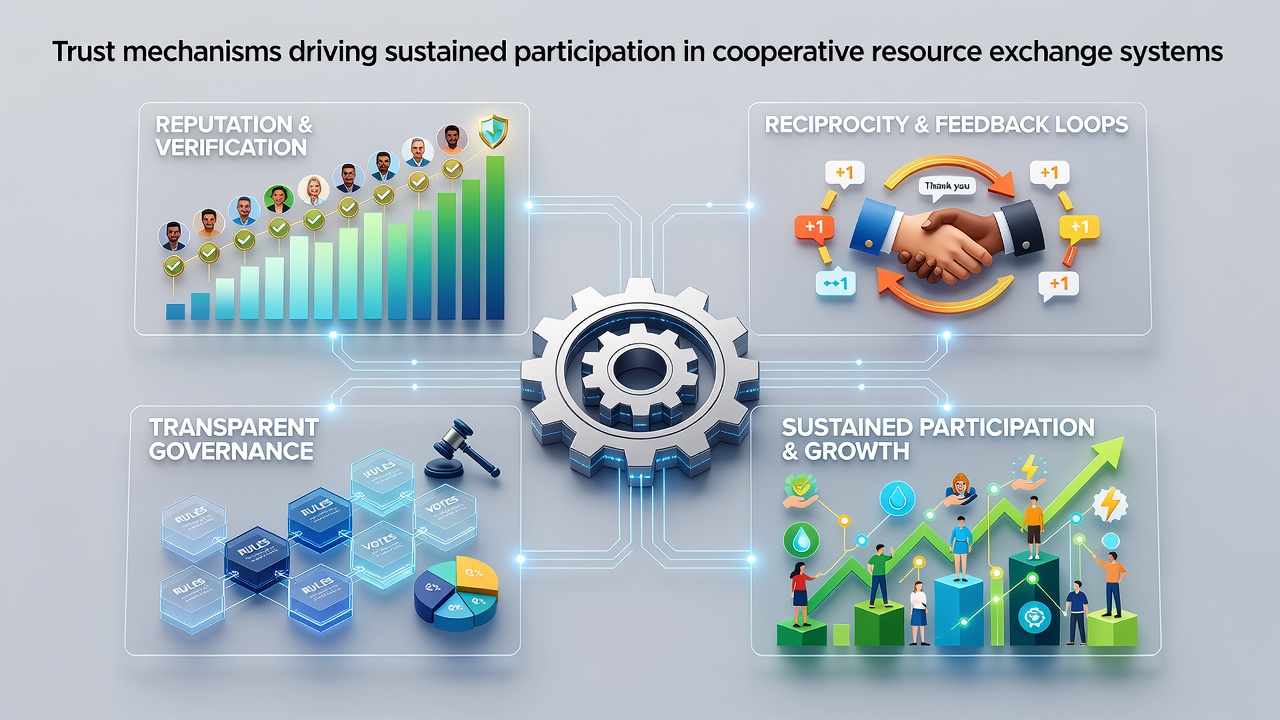
Cooperative resource exchange systems rely on structured trust mechanisms to maintain long-term user involvement, and these frameworks operate across platforms that facilitate sharing of goods, services, and knowledge among distributed participants. Data from multiple studies shows that systems incorporating identity verification, transparent transaction records, and formalized dispute resolution retain higher rates of repeated engagement compared to those without such structures.
Core Components of Trust Infrastructure
Identity verification processes form one foundational element, where participants submit documentation or undergo third-party checks before accessing exchange features, and this step reduces instances of misrepresentation while establishing baseline accountability. Researchers have documented that platforms applying multi-factor authentication and credential cross-referencing experience fewer fraudulent listings and higher completion rates for resource transfers. Reputation tracking systems complement verification by logging historical interactions, including successful exchanges, response times, and adherence to agreed terms, while aggregated scores become visible to all members and influence future matching opportunities.
Dispute resolution protocols provide another layer, often involving neutral mediators or automated arbitration rules that activate when conflicts arise over quality, timing, or fulfillment, and these procedures help restore equilibrium without requiring external legal intervention. Evidence from operational networks indicates that clear escalation paths and predefined remedies encourage continued participation because users perceive lower personal risk in each transaction.
Integration of Governance and Transparency Tools
Governance models in these systems frequently distribute decision-making authority through voting mechanisms or elected oversight committees, allowing participants to shape rule updates and enforcement priorities. According to reports compiled by the European Commission on collaborative economy practices, such participatory governance correlates with stronger retention metrics across member bases in several documented cases. Transparency features, including public ledgers of resource flows and audit trails for contributions, further reinforce trust by enabling independent verification of system integrity.
Observers note that when contribution histories remain accessible and immutable, individuals demonstrate increased willingness to commit resources over extended periods. As of November 2026, several established networks have expanded these transparency features to include real-time dashboards showing aggregate participation statistics, and usage data reveals corresponding upticks in sustained activity levels following those deployments.
Empirical Patterns in Participation Longevity
Longitudinal analyses conducted by academic research groups reveal consistent patterns where trust mechanisms directly influence duration of involvement. One study tracking multiple cooperative platforms over three years found that networks with layered verification and reputation systems retained approximately 40 percent more active users beyond the initial six-month period than those relying solely on basic registration. Participants in systems featuring automated feedback loops and periodic trust score recalibrations showed elevated rates of resource recontribution, suggesting that visible accountability structures reinforce behavioral continuity.
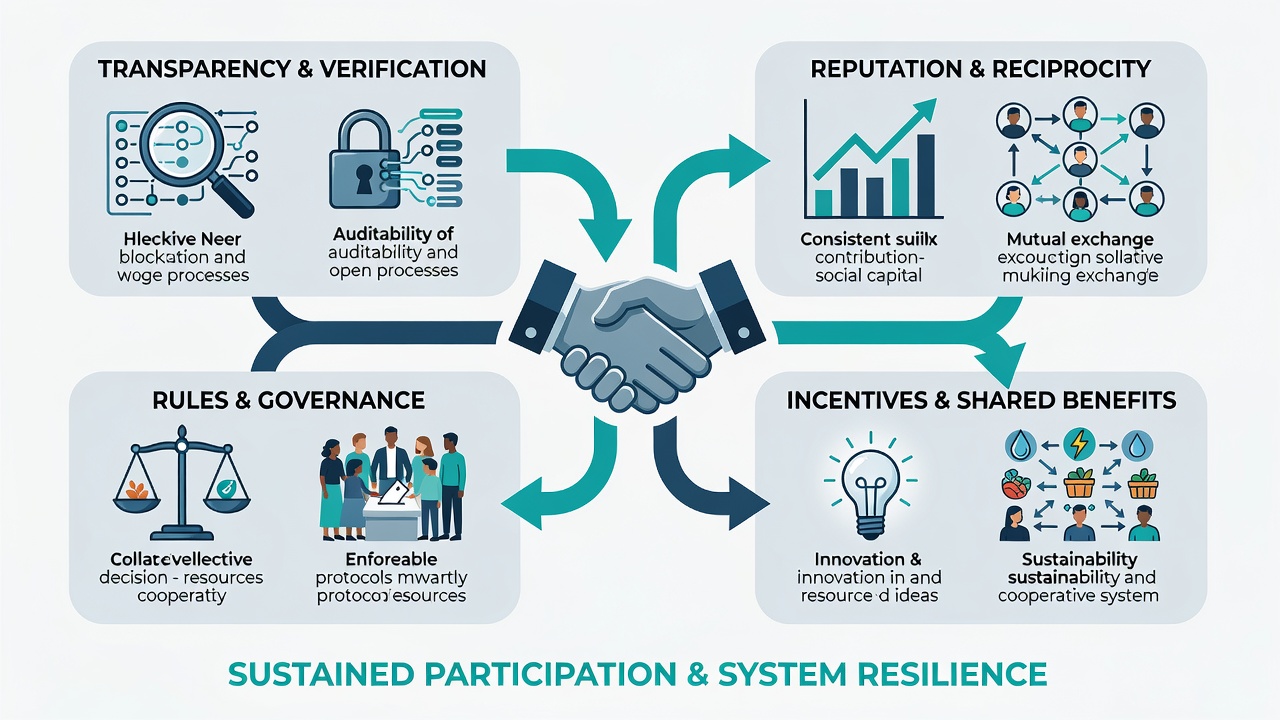
Take one research team that examined time-banking cooperatives across North America and Europe, and their findings indicate that formalized mediation reduced dropout rates by addressing mismatches promptly and restoring participant confidence. Data compiled through the OECD collaborative economy initiatives similarly highlights how transparency measures in resource pooling arrangements lead to broader network stability, with members reporting higher perceived reliability when transaction histories remain openly accessible.
Adaptations Across Different Resource Domains
Trust mechanisms adapt to specific resource types, with physical goods exchanges often emphasizing condition verification and return protocols, whereas knowledge-sharing systems prioritize expertise validation and content accuracy checks. In agricultural cooperatives, for example, certification of produce quality and origin tracking sustains farmer and consumer engagement by minimizing uncertainty around product standards. Digital resource exchanges, by contrast, implement version control and access logging to assure contributors that their inputs receive appropriate attribution and protection.
Those who've studied cross-domain applications observe that modular trust architectures, allowing customization of verification depth according to resource sensitivity, support broader adoption while maintaining core participation drivers. Figures from industry analyses show that platforms offering tiered trust options experience steadier growth in active membership compared to rigid, one-size-fits-all approaches.
Conclusion
Trust mechanisms in cooperative resource exchange systems encompass verification processes, reputation systems, governance structures, and transparency tools that collectively support continued participation. Research data demonstrates measurable links between these elements and retention outcomes across varied domains and geographic contexts. Continued refinement of such frameworks, informed by operational metrics gathered through 2026, positions these systems to maintain functional stability as participant bases expand and resource types diversify.